Free ebook · 6 min
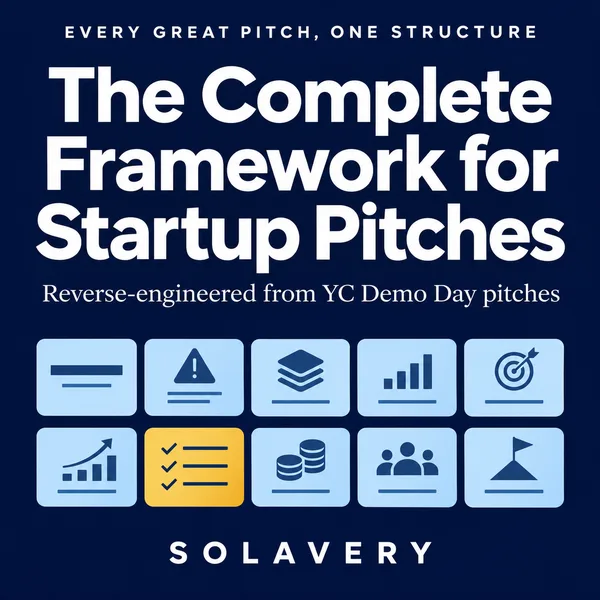
The $0 Billion Pitch Deck Checklist
A slide-by-slide checklist for clarity, evidence, economics, and a concrete ask.
Learn to build a clear pitch deck covering customer pain, product, market, traction, economics, competition, team, and use of funds.
- Pages
- 30
- Read Time
- 6 min
What's inside
This guide reviews the main slides in a startup pitch deck using weak and stronger examples. It emphasizes clear customer outcomes, verifiable evidence, bottom-up market sizing, unit economics, repeatable acquisition, and a funding ask connected to milestones.
Make the Problem and Solution Obvious
The opening slides should make the business easy to explain.
- Use a plain value proposition that identifies the customer and benefit.
- Describe who experiences the problem, its cost, and its frequency.
- Explain the solution through a simple workflow and a measurable outcome.
Show Why the Opportunity Exists
Timing, product evidence, and market math support the opportunity.
- Identify an external technology, regulatory, or behavior shift.
- Show real product screens and the workflow users experience.
- Build market size from customer counts and actual pricing.
Prove the Business Can Work
Traction and economics should demonstrate progress beyond publicity.
- Explain who pays, how much, how often, and the key economic assumptions.
- Show revenue, usage, and retention clearly.
- Describe real competitors and differences customers care about.
Explain How You Will Execute
Distribution and team experience help make the plan believable.
- Identify a primary acquisition channel and evidence that it works.
- Connect team achievements to the problem being solved.
- Present realistic near-term projections that match the growth strategy.
Connect the Ask to Outcomes
The funding request should explain what the money is meant to accomplish.
- State the amount sought and how it will be allocated.
- Tie hiring and spending to clear operating milestones.
- Check that the business can be explained simply and the numbers have support.
Made for: Early-stage founders preparing a pitch, deck or one-pager for investors.
Then talk it through with Sol
Sol Avery is Solavery's founder coach. Sol is a virtual coach, not a person. Bring your own startup and work out what this book means for it.